14. Do I Need Planning Permission for Solar Panels in Glasgow or Nearby Areas?
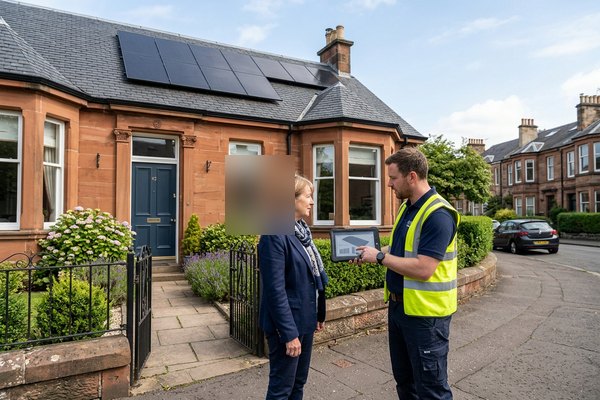
In many cases, you do not need planning permission for solar panels in Glasgow or nearby areas, because standard rooftop solar often falls under permitted development. However, that does not mean every property is identical, and it is still important to check whether anything specific about your home, roof, or location changes the position.
At Solar Panels Glasgow, we already state on our homepage that most rooftop solar installations are permitted development. We also note that if the inverter is larger than 3.68kW, a G99 approval may be required, and that this application can be handled as part of the installation process where necessary. That is a useful distinction because planning permission and grid approval are not the same thing. Source
For the main residential service overview, see Residential Solar Panels Glasgow.
Quick Answer: Planning Permission vs Other Approvals
IssueIs it the same as planning permission?Why it mattersStandard rooftop solar on a typical homeOften no planning permission neededUsually treated as permitted developmentGrid approval such as G99NoRelates to system export capacity and electrical connectionSpecial property or location restrictionsSometimesMay affect whether planning advice is needed
Many homeowners mix these up. The planning question is about whether the installation itself needs formal planning consent. The grid question is about how the system connects and exports electricity.
When Solar Panels Are Usually Permitted Development
For many ordinary homes in Glasgow and surrounding areas, solar panels can be installed without a full planning application, provided the system meets the relevant conditions. That is why so many residential systems move forward without the homeowner needing to navigate a lengthy planning route.
In practice, this is why most homeowners start by asking an installer rather than the planning office. A good installer will quickly flag whether the property looks routine or whether there is any reason to check more carefully.
When You Should Check More Closely
There are situations where extra care is sensible. Even if solar is usually permitted development, you should slow down and check if:
the property has unusual planning restrictions
it sits in a more sensitive setting
the roof design or installation proposal is less straightforward
the home is not a standard domestic setup
The point is not to create unnecessary concern. It is simply to avoid assuming that every roof is treated identically.
Planning Permission Is Not the Same as G99 Approval
This is one of the most important distinctions for Glasgow homeowners. On our website, we explain that where the inverter is above 3.68kW, a G99 application may be required and can be handled during the project. That is an electrical and grid-connection matter, not the same thing as local planning permission. Source
So if someone tells you that “approval is needed,” the next question should be: approval from whom, and for what?
What Homeowners Should Ask Before Installation
To keep the process clear, ask these questions at quote stage:
Is my roof installation likely to be treated as permitted development?
Are there any known local restrictions that make the property unusual?
Will the proposed inverter size trigger a G99 application?
Who will handle any required paperwork?
Is anything about the system design likely to affect approvals?
Good installers should be able to answer these questions in plain English.
Nearby Areas: Does the Answer Change Outside Glasgow?
Often the general position remains similar in nearby towns and suburbs, but homeowners should not assume total uniformity. A property in Bearsden, Newton Mearns, Paisley, or East Kilbride may still be routine, but site-specific factors can always affect what needs checking.
That is why local experience matters. A quote based on real property details is more useful than a broad internet answer that does not consider the roof, location, or system size.
Why This Matters for Project Timelines
If no extra planning route is needed, a project can move more smoothly. On our homepage, we note that a typical solar installation process often runs around 4 to 8 weeks from quote to activation, and longer if a G99 approval is needed. Understanding the approval side early helps set realistic expectations for timing. Source
FAQs
Do I usually need planning permission for solar panels in Glasgow?
Usually not for standard rooftop installations on typical homes, as these are often treated as permitted development. However, homeowners should still check if the property has anything unusual about it.
What is G99 approval?
G99 approval is a grid-related application for certain system sizes. It is not the same thing as planning permission.
Can nearby areas have different requirements?
The general approach is often similar, but site-specific factors can change what needs checking. That is why property-level assessment matters.
Will approvals delay installation?
They can, especially if a G99 application is needed. This is why approval questions should be discussed before the project starts.
Want Clarity Before You Start the Quote Process?
If you want a practical view of whether your home is a routine solar installation and what approvals may apply, visit the Solar Panels Glasgow homepage. We can help you understand the difference between planning permission, grid approval, and normal project timelines. Source
