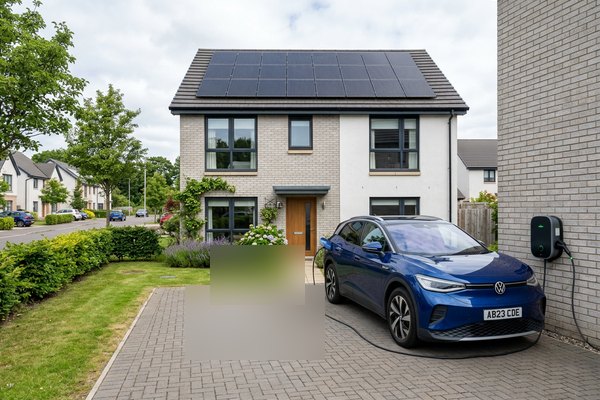
9. Can Solar Panels Charge an EV at Home in Glasgow?
Yes, solar panels can charge an EV at home in Glasgow, and for many households it is one of the most practical reasons to install solar in the first place. If you already have an electric vehicle, or plan to buy one soon, pairing solar panels with a home charger can cut running costs, make better use of your daytime generation, and reduce how much electricity you buy from the grid.
At Solar Panels Glasgow, we already explain on our homepage that a typical local 4kW system can generate around 2,900 to 3,400 kWh per year, and that many homeowners save £500 to £900 annually on electricity, with more potential upside when battery storage is included. Once an EV is added to the picture, the value of self-generated electricity often becomes even clearer because transport costs shift from petrol or diesel to household electricity. Source
If your main interest is the charging side, start with our EV Chargers Glasgow service page.
Quick Answer: Can Solar Fully Charge an EV?
It can help significantly, but whether it fully charges your EV depends on the size of your solar system, the battery size of the vehicle, the time of year, and when the car is parked at home.
ScenarioWhat happens in practiceBest fitSolar panels onlyEV charges from live solar when the car is home in daylightDaytime parking, home workersSolar + smart chargerCharger prioritises surplus solar more effectivelyHouseholds wanting better controlSolar + battery + smart chargerDaytime solar can support evening charging tooHigher-use or future-focused homesEV charging only from gridReliable, but less efficient financiallyHomes without solar
In Glasgow, the strongest results usually come when the charger, solar system, and household habits are planned together rather than separately.
How Solar EV Charging Works at Home
Solar panels generate electricity during daylight hours. If your EV is plugged in while the system is producing power, part of that electricity can go straight into the car instead of being imported from the grid.
A few practical points matter:
if the car is away during the day, direct solar charging is more limited
a smart charger can help match charging to periods of solar generation
a home battery can store daytime solar for use later in the day
larger household electricity demand means solar needs to be sized properly
The process is not all-or-nothing. Even if solar does not cover every mile you drive, it can still reduce the cost of charging substantially over time.
Is Glasgow a Good Fit for Solar EV Charging?
Yes. Even with Scotland’s changeable weather, solar can still produce useful annual output. Our site already notes that solar performs in local diffuse light and that a typical system can achieve meaningful yearly generation in Glasgow conditions. That matters because EV charging is not judged by one grey winter day. It is judged over the full year. Source
Homes in Glasgow often make good use of solar EV charging when:
one car is parked at home during working hours
the homeowner uses scheduled charging intelligently
the system includes battery storage for evening flexibility
the property has enough roof space for a sensibly sized array
Solar Charging vs Grid Charging
Solar-first charging
This is the cheapest energy in the long run because it uses electricity you have generated at home. It is especially attractive for households that already have solar panels or are planning an installation.
Grid-only charging
Grid charging is simple and dependable, but it leaves you exposed to energy tariffs. It also means you miss the opportunity to use self-generated daytime electricity.
Mixed charging is the real-world norm
Most Glasgow households will use a mix of both. In summer, solar may cover a larger share of charging needs. In winter, the grid will usually play a bigger role. That is normal.
Should You Add a Battery Too?
A battery is not essential for solar EV charging, but it can improve the value of the system. It allows some of the solar produced in the middle of the day to be stored and used later when the car returns home or when the home itself needs more electricity.
If evening charging matters to you, our Solar Battery Storage page is the next logical read.
How Big a Solar System Do You Need?
There is no one-size-fits-all answer. The right size depends on:
how many miles you drive each week
whether you want to offset household demand as well as EV charging
your usable roof area
whether you plan to add a battery
A family in Glasgow with modest commuting needs may be well served by a typical residential system, while a high-mileage driver with heavy evening demand may need a more tailored setup.
Who Benefits Most From Solar EV Charging?
You are likely to see the best results if:
you already own or are about to buy an EV
you have suitable roof space
the car is often at home in daylight hours, or you plan to add a battery
you want to reduce both electricity bills and driving costs
Solar plus EV charging is also a strong long-term fit for homeowners who expect their property to become more electric over time.
FAQs
Can solar panels fully charge an EV in Glasgow?
They can cover part or, in some situations, a large share of EV charging, but this depends on solar system size, season, and whether the car is available to charge during the day.
Do I need a special EV charger to use solar power?
A smart EV charger is usually the best option because it can make solar charging more efficient and easier to manage.
Is battery storage worth it for EV charging?
It often is if you want to use daytime solar later in the evening, especially when the car is not parked at home during peak solar hours.
Do solar panels still help with EV charging in winter?
Yes, but they contribute less in winter than in spring and summer because output is seasonal. Over a full year, though, the savings can still be meaningful.
Want to Plan Solar and EV Charging Together?
If you want a system that supports both household savings and cheaper driving, visit the Solar Panels Glasgow homepage. We can help you compare solar, battery storage, and EV charging options based on your roof, driving habits, and energy use. Source
